What is Ceramic Coating? And How Does It Work?
If you take pride in keeping your vehicle looking brand new, you have likely heard about ceramic coating. Car enthusiasts, professional detailers, and everyday drivers talk about it as the ultimate form of exterior paint protection. But with so much hype around this automotive care product, it is easy to wonder: What is ceramic coating, really? How does it actually work, and is it worth the investment for your vehicle?
In this comprehensive guide, we will break down the science, benefits, process, and misconceptions behind ceramic coatings in plain, easy-to-understand language.
What Exactly Is a Ceramic Coating?
At its core, a professional ceramic coating is a liquid polymer solution applied to the exterior surfaces of a vehicle. The primary active component in high-grade ceramic coatings is Silicon Dioxide ($\text{SiO}_2$), often derived from quartz or sand crystals, sometimes blended with Titanium Dioxide ($\text{TiO}_2$) for added hardness and gloss.
Unlike traditional car waxes or synthetic paint sealants—which simply sit loosely on top of your paint like a temporary blanket—a ceramic coating forms a chemical bond with your vehicle’s factory clear coat.
Once cured, this chemical reaction creates a hydrophobic (water-repelling), semi-permanent sacrificial layer over your paintwork. Think of it as an ultra-thin, glass-like shield that protects your car’s finish from everyday environmental wear and tear.
How Does Ceramic Coating Work? The Science Made Simple
To understand how a ceramic coating works, you first need to look at your car’s paint under a microscope.
Even on a brand-new vehicle, factory paint is not completely smooth. It contains microscopic peaks, valleys, and pores. Over time, dirt, dust, water droplets, bird droppings, and industrial fallout lodge themselves into these microscopic pockets, causing contamination, oxidation, and loss of shine.
Here is step-by-step how the ceramic coating technology works:
- Filling the Nanopores: When the liquid coating is applied to clean paint, the nano-sized particles penetrate deep into the microscopic pores of your clear coat.
- Covalent Chemical Bonding: Rather than remaining a separate layer, the polymer chemically reacts with the clear coat molecules, bonding to the surface.
- Hardening into a Glass-Like Shield: As the solvent evaporates, the coating cures into a hard, clear, crystal-like structure.
- Creating a Superhydrophobic Surface: The cured surface alters the surface tension of the paint. Water, oils, and liquids can no longer stick or spread out; instead, they bead up into tight spheres and slide off effortlessly.
Key Benefits of Ceramic Coating Your Vehicle
Investing in a ceramic coating provides several major advantages over traditional waxing or leaving your paint exposed.
1. Exceptional Hydrophobic Properties (The “Self-Cleaning” Effect)
One of the most satisfying features of a ceramic-coated car is how water behaves on it. Water instantly beads up and rolls off the surface. As the water slides off, it picks up light surface dust and dirt along with it. While this doesn’t mean you will never have to wash your car again, it dramatically reduces how often you need to clean it and makes washing effortless.
2. Protection Against UV Rays and Oxidation
Constant exposure to sunlight’s ultraviolet (UV) rays causes automotive clear coats to break down over time. This oxidation leads to faded colors, dull paint, and chalky patches—especially on red, black, and dark blue vehicles. A ceramic coating blocks UV rays, preserving the rich depth and vibrance of your original paint color for years.
3. Resistance to Chemical Stains and Etching
Environmental pollutants like acid rain, bird droppings, tree sap, and bug splatter contain harsh chemicals and acids. On untreated paint, these substances eat into the clear coat within hours, leaving permanent etching marks. The durable chemical barrier of a ceramic coating prevents acidic contaminants from reaching the clear coat, giving you ample time to wipe them away safely.
4. Unmatched Gloss, Depth, and Shine
If you love a deep, mirror-like finish, ceramic coatings deliver results that waxes simply cannot match. By creating an exceptionally smooth, uniform surface layer, light reflects off your car’s body panels with crisp clarity, enhancing the gloss and metallic flake in your paint.
5. Long-Lasting Durability
- Traditional Car Wax: Lasts 4 to 8 weeks.
- Synthetic Paint Sealants: Lasts 3 to 6 months.
- Professional Ceramic Coatings: Lasts anywhere from 2 to 5+ years with proper maintenance.
Common Misconceptions: What Ceramic Coating CANNOT Do
While ceramic coatings offer incredible protection, there are a few persistent myths in the automotive world that need clarifying.
- Myth #1: Ceramic coatings make your car completely scratch-proof.
- Fact: While ceramic coatings do add a degree of surface hardness (often rated up to 9H on the pencil hardness scale), they do not make your car immune to deep scratches, rock chips, key marks, or aggressive automatic car brush swirls. For heavy impact protection against stone chips, a heavy Paint Protection Film (PPF) is required.
- Myth #2: You never have to wash your car again.
- Fact: Ceramic-coated vehicles are easier to wash, but they still get dirty. Road grime, brake dust, and mud will still cling to the surface over time. Regular washing with a pH-neutral car shampoo is essential to maintain the coating’s performance.
- Myth #3: Anyone can apply a high-end ceramic coating in 10 minutes.
- Fact: Applying a high-grade ceramic coating is a meticulous multi-step process that requires time, precision, and proper environmental control.
The Professional Application Process Explained
To get the full benefits of a ceramic coating, surface preparation is crucial. You cannot simply wipe a ceramic coating onto a dirty or scratched car; doing so will permanently trap imperfections underneath the hard shield.
- Step 1: Decontamination Wash — The car is thoroughly washed, followed by a clay bar treatment to pull embedded iron particles, tar, and grit out of the paint pores.
- Step 2: Paint Correction — The vehicle undergoes machine polishing (1-step or 2-step compound and finish) to remove swirl marks, fine scratches, and haze.
- Step 3: Panel Wipe — An isopropyl alcohol (IPA) solution is wiped over every panel to strip away leftover polish oils, leaving a completely bare clear coat.
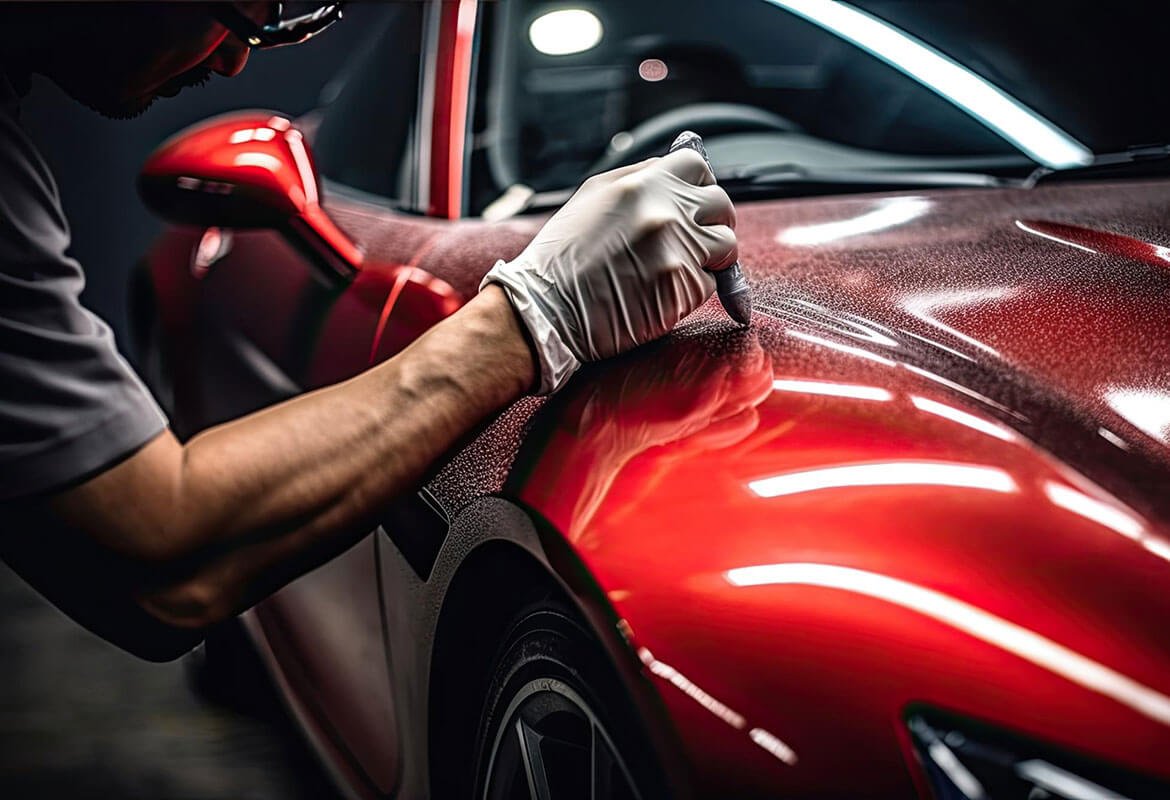
- Step 4: Coating Application — The technician applies the liquid coating section by section using a micro-applicator pad, allowing it to “flash” (rainbow effect), and then buffing away the excess level with clean microfiber towels.
- Step 5: Curing — The vehicle must remain in a dry, climate-controlled environment for 12 to 24 hours so the chemical bonds can fully cross-link and harden before being exposed to rain or moisture.
How to Maintain Your Ceramic Coating
To ensure your ceramic coating lasts its full expected lifespan, follow these simple maintenance best practices:
- Use the Two-Bucket Wash Method: Use one bucket for soapy water and one bucket for rinsing your wash mitt to prevent grit from scratching the coating.
- Choose pH-Neutral Shampoos: Avoid harsh dish soaps, degreasers, or aggressive acidic cleaners that can weaken the coating’s hydrophobic properties.
- Avoid Touch Car Washes: Heavy rubber brushes in automatic car washes trap dirt from previous vehicles and will create heavy swirl marks on your finish.
- Apply Top-Up Spray Sealants: Using a ceramic booster spray every 3 to 6 months helps refresh the hydrophobic top layer and keeps the surface extra slick.
Final Thoughts: Is Ceramic Coating Worth It?
If you treat your vehicle as an investment and want to keep it looking immaculate with minimal maintenance effort, yes, ceramic coating is absolutely worth it.
It eliminates the tedious routine of re-waxing your car every couple of months while providing superior defense against UV rays, acid rain, bird droppings, and industrial fallout. While it requires an upfront investment—especially for proper paint preparation—the long-term paint preservation, deep mirror shine, and ease of cleaning make it one of the most rewarding upgrades you can give your vehicle.